Pronounced like “du” in “dud”
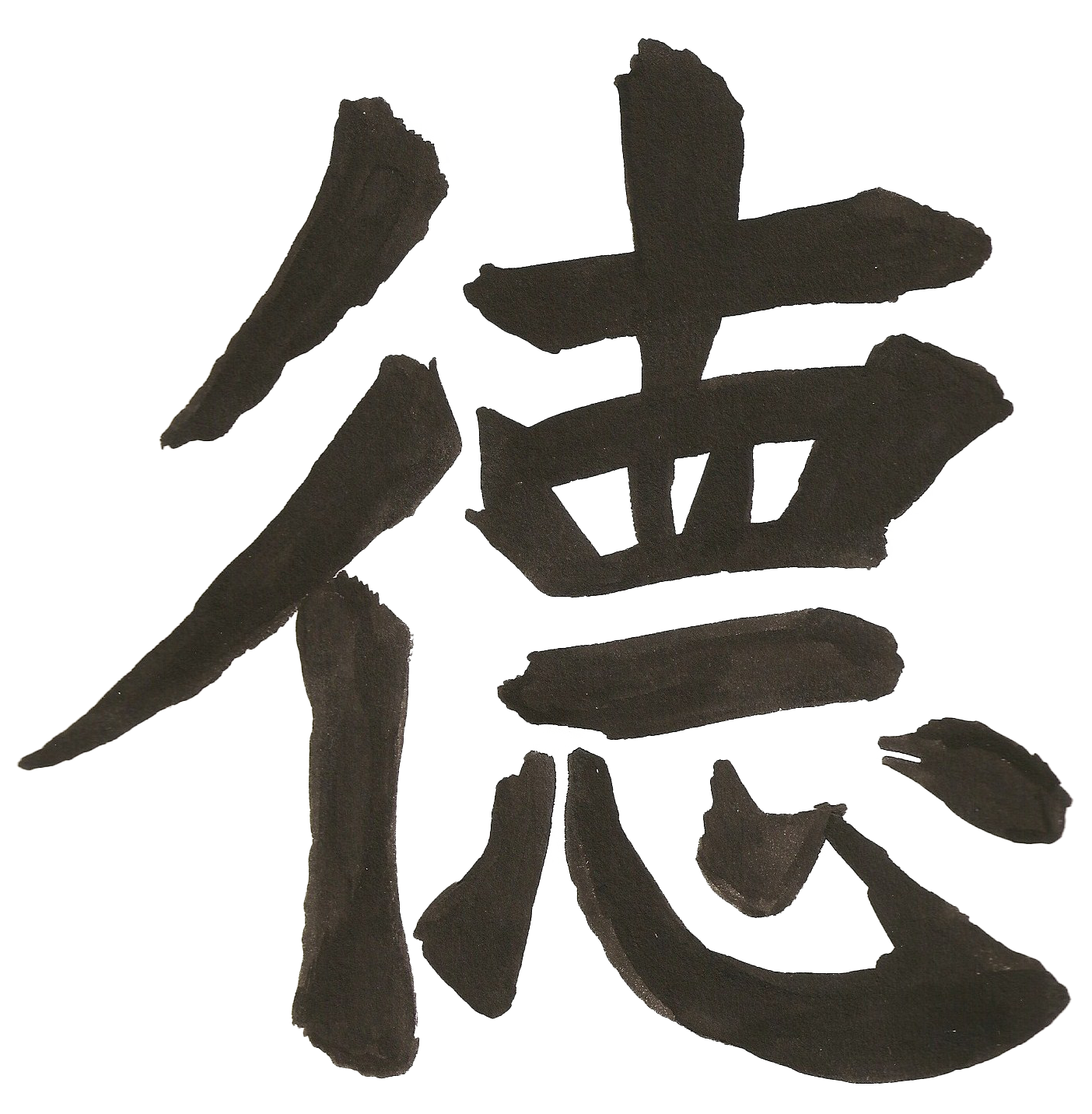
- the idea of te is power exercised without the use of force and without undue interference with the order of surrounding circumstances.
- Going back to the original form of the ideogram, te means going along with unity of eye and heart (mind). This is intelligent perception of the course of things, as the navigator observes the stars and the sailor watches the currents and winds.
The chances of survival are best when there is no anxiety to survive, and that the greatest power (te) is available to those who do not seek power and who do not use force.
The conscious control of life seems to involve us in ever more bewildering webs of complexity so that, despite their initial successes, technics create more problems than they solve.
Confucians, along with Hebrew, Islamic, and Catholic scholastics, as well as Protestant fundamentalists, are like tourists who study guidebooks and maps instead of wandering freely and looking at the view.
This is why there are no rules for te, and why there can be no textbook for instructing judges and lawyers in the senses of equity and fair play.
The senses, feelings, and thoughts must be allowed to be spontaneous (tzu-an) in the faith that they will then order themselves harmoniously. To try to control the mind forcefully is like trying to flatten out waves with a board, and can only result in more and more disturbance. At root, then, the idea of te is power exercised without the use of force and without undue interference with the order of surrounding circumstances.
In all this you will see that there are three stages. There is first what we might call the natural or the childlike stage of life in which self-consciousness has not yet arisen. Then there comes a middle stage, which we might call one’s awkward age, in which one learns to become self-conscious. And finally, the two are integrated in the rediscovered innocence of a liberated person. And so, the secret in Taoism is to get out of one’s own way, and to learn that this pushing ourselves, instead of making us more efficient, actually interferes with everything we set about to do.
We have all admired the spontaneity and freshness of children, and it is regrettable that as children are brought up they become more and more self-conscious. In this way people often lose their freshness, and more and more human beings seem to be turned into creatures calculated to get in their own way.
When the Confucians prescribed a virtue which depended upon the artificial observance of rules and precepts, the Taoists pointed that such virtue was conventional and not genuine.
Taoism is not a philosophy of compelling oneself to be calm and dignified under all circumstances. The real and astonishing calm of people like Lao-tzu comes from the fact that they are willing, without shame, to do whatever comes naturally in all circumstances. The unbelievable result is they are far more sociable and civilized that those who try to live rigorously by laws and watchwords.