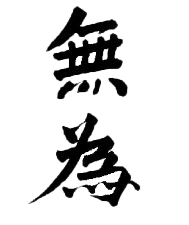
Often misunderstood as ‘not trying’. But this is another Ying-Yang concept… being both active and passive at the same time!
Not forcing / Going with the flow / Not obstructing.
Not forcing but living in skillful harmony with the processes of nature instead of trying to push them around.
The following story, ‘Chaotic Currents’ is from The Tao of Happiness: Stories from Chuang Tsu for your Spiritual Journey by Derek Lin (page 33)

Confucius and his students went on a hike in the Liu Liang area, to explore its natural beauty. They saw a waterfall from a distance, so they began walking toward it. They could see that it was huge, and its water fell from such a great height that it splashed down with tremendous force. They could hear a deep rumble and see the mist generated by the splashing torrents. Confucius remarked: “That water at the bottom of the fall is so powerful and dangerous that not even fish and turtles can get near it. This is all the more interesting because we usually think of water as their native element.” When they got close enough for a better look, they were all surprised by the sight that greeted them. They saw a man in the waterfall being spun around in the ferociously churning water, whipped this way and that by the terrifying currents. “Quickly, to the rescue!” Confucius commanded. “He must have fallen in by accident, or perhaps he is suicidal. Either way, we must save him.” They ran as fast as they could. A moment later, they arrived at the river downstream from the waterfall. They expected to see the man seriously injured or dead. Instead, they saw him swimming casually away from the waterfall, spreading his long hair out and singing loudly, evidently having a great time. They were dumbfounded. When he got out of the river, Confucius went to speak with him: “Sir, I thought you must be some sort of supernatural being, but on closer inspection I see you are an ordinary person. How can it be that you were not harmed by the waterfall? Do you possess some special skills?” “No, I have no special skills whatsoever,” the man replied. “I simply follow the nature of the water. That’s how I started with it, developed a habit of it, and derived lifelong enjoyment from it.” “This ‘follow the nature of the water’ — can you elaborate? How exactly does one follow the nature of water?” “Well… I don’t really think about it very much. If I had to describe it, I would say that when the powerful torrents twist around me, I turn with them. If a strong current drives me down, I dive alongside it. As I do so, I am fully aware that when we get to the riverbed, the current will reverse course and provide a strong lift upward. When this occurs, I am already anticipating it, so I rise together with it. Although the water is extremely forceful, it is also a friend that I have gotten to know over the years, so I can sense what it wants to do, and I leverage its flow without trying to manipulate it or impose my will on it.” “How long did it take for you to make all this an integrated part of your life?” “I really can’t say. I was born in this area, so the waterfalls have always been a familiar sight to me. I grew up playing with these powerful currents, so I have always felt comfortable with them. Whatever success I have with water is simply a natural result of my lifelong habit. To be quite frank, I have no idea why this approach works so well. To me, it’s just the way life is.”
Alan Watts (from Tao: The Watercourse Way)…
“Thus wu-wei as “not forcing” is what we mean by going with the grain, rolling with the punch, swimming with the current, trimming sails to the wind, taking the tide at its flood, and stooping to conquer.”
See the YouTube video ‘Wu-wei | The Art of Letting Things Happen’ (Einzelganger). https://youtu.be/g0rhN8U14dk
The following quotes are from Andrew Beaulac, Sitting with Lao-Tzu…
“One of the most essential themes of the Dao De Jing is wu-wei, (not-doing) which is the efficiency of not-forcing or meddling in things. But understanding the effectiveness of non-action is predicated on a basic trust of nature, and of the principle that the most beneficial events happen spontaneously, or “of themselves.” Nature, in Chinese, is ziran (often written “tzu-jan”) and means “of itself so.” The best action is that which happens of itself. Reading the Dao De Jing one finds the most authenticity and efficiency in the most natural events, the most spontaneous actions, that is, in what is without external contrivance or forcing.”
“Following the Way essentially depends on the realization that one is not discontinuous with the Way. Wu wei eludes many because it isn’t realized through arguments or persuasion. It is better realized by simply “sitting quietly with the Universe” until we realize that our separation is mental and nothing else. All things arise from the Source, transform, and then return to the Source.”
“The “emptiness” gives birth to the manifest worlds, or, as Laozi would say, “The Dao gives birth to all things. Its power nourishes them, matter gives them form, and their inclinations complete them. “Contemplating yourself as continuous with this universal Dao is the first step toward any significant changes in your life, and a prerequisite for acting in wu-wei.” “Acting without “acting,” without artifice, force, or over-controlling, is not a practice to be implemented like a program of self-improvement. That itself would be artifice and “doing.” Rather, wei wu wei arises out of a new way of perceiving the world. Any new way of living, if it is to be authentic and escape hypocrisy, must arise out of a new vision of reality. One must come to a fundamental trust of the natural Universe and its inherent intelligence, and have a feel for our place in it, indeed, feel ourselves as it, before one can act wu wei.”