Live in the ancient Tao,
Master the existing present,
Understand the source of all things.
This is called the record of Tao.
– Tao te Ching, 14
- Only now exists now, the present moment. The past no longer exists now; it is a fading memory. Nor does the future exist now; it is an expectation.
- The emphasis of Taoism is on the present now being the only reality now.
“Our consciousness is almost completely preoccupied with memory and expectation. We do not realize that there never was, is, nor will be any other experience than present experience. We are therefore out of touch with reality.”
See also Alan Watt’s Life is not a Journey – https://youtu.be/rBpaUICxEhk
The following is from Alan Watts, Become What You Are.
It has been said that the highest wisdom lies in detachment, or, in the words of Chuang-tzu: ‘‘The perfect man employs his mind as a mirror; it grasps nothing; it refuses nothing; it receives but does not keep.’’ Detachment means to have neither regret for the past nor fears for the future; to let life take its course without attempting to interfere with its movement and change, neither trying to prolong the stay of things pleasant nor to hasten the departure of things unpleasant. To do this is to move in time with life, to be in perfect accord with its changing music, and this is called Enlightenment. In short, it is to be detached from both past and future and to live in the eternal Now. For in truth neither past nor future have any existence apart from this Now; by themselves they are illusions. Life exists only at this very moment, and in this moment it is infinite and eternal. For the present moment is infinitely small; before we can measure it, it has gone, and yet it persists for ever. This movement and change has been called Tao by the Chinese, yet in fact there is no movement, for the moment is the only reality and there is nothing beside it in relation to which it can be said to move. Thus, it can be called at once the eternally moving and eternally resting. How can we bring ourselves into accord with this Tao? A sage has said that if we try to accord with it, we shall get away from it. But he was not altogether right. For the curious thing is that you cannot get out of accord with it even if you want to; though your thoughts may run into the past or the future they cannot escape the present moment. However far back or forward they try to escape they can never be separated from the moment, for those thoughts are themselves of the moment; just as much as anything else they partake of, and, indeed, are the movement of life which is Tao. You may believe yourself out of harmony with life and its eternal Now; but you cannot be, for you are life and exist Now — otherwise you would not be here. Hence the infinite Tao is something which you can neither escape by flight nor catch by pursuit; there is no coming toward it or going away from it; it is, and you are it. So become what you are.
The following is from Alan Watts, What is Zen? (edited by Mark Watts & Marc Allen, 2000)
There never will be anything else except the present. Life is always present, and the past is a kind of echo, a tracing within the present of what the present did before. We can say, “Oh well, we can guess what the present will do next because of what it has done in the past.” And this is true: Because of what it does habitually, you may guess it will go on doing it like that. But still, it is not the past that controls the present any more than the wake controls the ship. Now from the record of the past you can study the nature of the present and predict what sort of things it’s likely to do. But sometimes it surprises you when something new happens, as every so often it does.
It is difficult for us to understand this, however, unless we turn things around, as in the analogy of the ship and the wake. If you understand fully that it is from the present that everything happens, then the only place for you to be, the only place for you to live, is here, right now. People immediately say, however, “Now wait a minute. That’s all very well, but I want to be sure that under such – and – such circumstances and in such – and – such eventualities I will be able to deal with it. It’s all very well to live in the present when I am sitting comfortably in a warm room reading this, or meditating, but what am I going to do if all hell breaks loose? What if there’s an earthquake, or if I get sick, or my best friends get sick, or some catastrophe happens? How will I deal with that? Don’t I have to prepare myself to deal with those things? Shouldn’t I get into some sort of psychological training, so that when disasters come I won’t be thrown?” That, you would ordinarily think, is the way to proceed — but it doesn’t work very well. It is much better to say, “sufficient unto the day is the trouble thereof,” and to trust yourself to react appropriately when the catastrophe happens. Whatever happens, you’ll probably have to improvise, and failure of nerve is really failure to trust yourself. You have a great endowment of brain, muscle, sensitivity, intelligence — trust it to react to circumstances as they arise.
But if you really know how to live from your centre, you live now, and know that now is the origin of everything. This way, you stand a much better chance of being able to deal with the unforeseen than if you keep worrying about it and considering past lessons and future possibilities.
If you expect something to come in a certain way, you position yourself to get ready for it. If it comes another way, by the time you reposition your energy, it is too late. So, stay in the centre, and you will be ready to move in any direction.
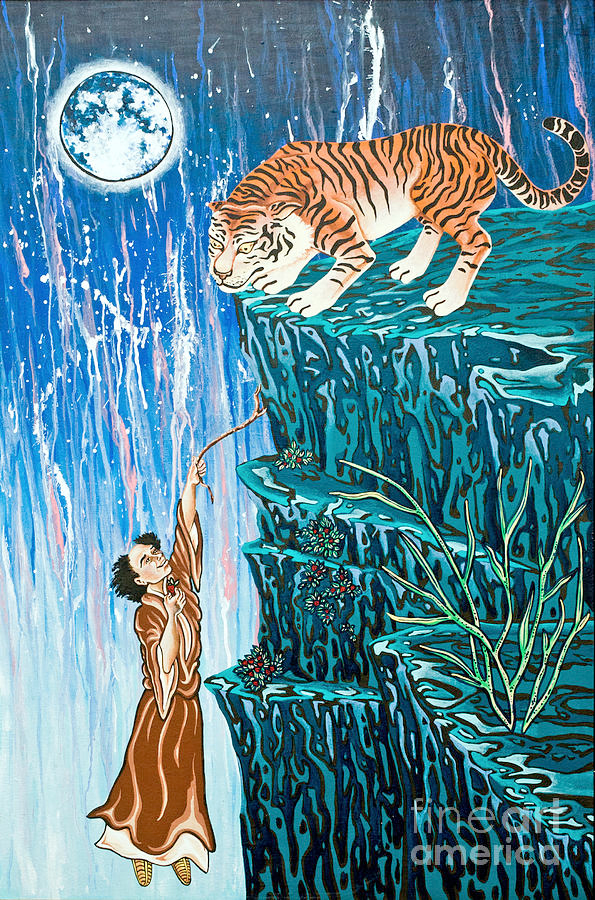
This story is found in Derek Lin’s The Tao of Daily Life. It is a ‘koan’ from the Zen Buddhist tradition.
One day, while walking through the wilderness, a man encountered a vicious tiger. He ran for his life, and the tiger gave chase.
The man came to the edge of a cliff, and the tiger was almost upon him. Having no choice, he held on to a vine with both hands and climbed down.
Halfway down the cliff, the man looked up and saw the tiger at the top, baring its fangs. He looked down and saw another tiger at the bottom, waiting for his arrival and roaring at him. He was caught between the two.
Two rats, one white and one black, showed up on the vine above him. As if he didn’t have enough to worry about, the rats started gnawing on the vine.
He knew that as the rats kept gnawing, they would reach a point when the vine would no longer be able to support his weight. It would break and he would fall. He tried to shoo the rats away, but they kept coming back.
At that moment, he noticed a strawberry growing on the face of the cliff, not far away from him. It looked plump and ripe. Holding on to the vine with one hand and reaching out with the other, he plucked it.
With a tiger above, another below, and two rats continuing to gnaw on his vine, the man tasted the strawberry and found it absolutely delicious.
The tiger at the top of the cliff represents the past, and the tiger at the bottom represents the future.
The rats gnawing on the vine are like the association we make between ‘time’ and decay.
Living in the ‘now’, the man sees the strawberry, and it is delicious!